
Every EHS team understands the importance of corrective actions.
Audit findings need follow-up. Incident investigations generate recommendations. Process Hazard Analyses (PHAs) identify gaps. Management of Change (MOC) reviews uncover actions that must be completed before risks are fully addressed.
Yet many organizations still track these critical items in spreadsheets.
At first, it seems manageable. One spreadsheet for audits. Another for incidents. A separate file for PHA recommendations. Maybe a shared tracker for MOC actions.
Over time, however, the system starts to break down.
The result? Corrective actions slip through the cracks, accountability becomes unclear, and auditors continue finding the same issues year after year.
The Spreadsheet Problem Nobody Talks About

Spreadsheets are easy to create but difficult to govern. Most facilities don’t have a single source of truth for action items. Instead, actions are scattered across departments, systems, and individual owners.
Consider a typical scenario:
- A process safety audit generates 25 findings.
- A PHA revalidation identifies 40 recommendations.
- An incident investigation produces several corrective actions.
- A recent MOC review creates additional follow-up items.
Each activity generates actions, but they often end up in different files maintained by different people.
Soon, teams start asking familiar questions:
- Which actions are overdue?
- Who owns each item?
- Has this recommendation actually been completed?
- Was closure verified?
- Are there duplicate actions addressing the same issue?
When the answers aren’t clear, risk increases.
Why Findings Keep Reappearing
One of the most frustrating experiences during an audit is seeing the same finding return year after year. In many cases, the issue isn’t a lack of effort. It’s a lack of visibility. Without centralized corrective action tracking software, organizations struggle to:
- Track status consistently
- Escalate overdue actions
- Verify completion
- Maintain closure documentation
- Demonstrate compliance during audits
Organizations that already manage audits through a structured process often discover that the real challenge begins after findings are issued. Corrective actions need the same level of discipline as the audit process itself. Learn more about process safety audit management here.
An action may be marked “complete” in one spreadsheet while supporting evidence sits in an email chain or shared drive. Months later, nobody can easily prove the work was performed or validated.
When auditors review the records, the finding resurfaces.
The Hidden Cost of Manual Tracking
The costs associated with spreadsheet-based tracking extend beyond compliance concerns. EHS professionals often spend significant time:
- Updating multiple trackers
- Chasing action owners for status updates
- Preparing audit evidence
- Reconciling conflicting information
- Building manual reports for leadership
This administrative burden reduces the time available for higher-value safety and risk reduction activities. Meanwhile, leadership lacks real-time visibility into outstanding actions and emerging compliance risks.
A spreadsheet may appear inexpensive, but the operational cost can be substantial.
What Effective Corrective Action Tracking Looks Like
Modern EHS corrective action software provides a centralized system for managing actions from multiple sources. Instead of maintaining separate trackers, organizations can capture and manage actions generated by:
- Audits
- Inspections
- Incident investigations
- PHA studies
- MOC reviews
- Compliance assessments
Every action follows a consistent workflow with defined ownership, due dates, status tracking, and closure verification. This creates a clear audit trail from assignment through completion. Most importantly, teams gain visibility into all open actions in one place.
For facilities covered by Process Safety Management requirements, maintaining documentation and ensuring recommendations are addressed is a key compliance expectation. The Occupational Safety and Health Administration (OSHA) provides guidance through its Process Safety Management standard: https://www.osha.gov/process-safety-management
Beyond CAPA: Creating Accountability
Many organizations invest in CAPA software for industrial operations because they need more than a list of open tasks. They need accountability.
A centralized action item tracking EHS system helps answer critical questions:
- Which actions are overdue?
- Which departments have the highest backlog?
- What corrective actions are approaching due dates?
- Where are closure bottlenecks occurring?
- Which findings remain unresolved?
With this visibility, managers can address issues before they become audit findings or compliance gaps.
A Single System for Action Management
The challenge isn’t generating corrective actions. Most organizations generate plenty of them.
The challenge is ensuring they are completed, documented, verified, and available for review when needed.
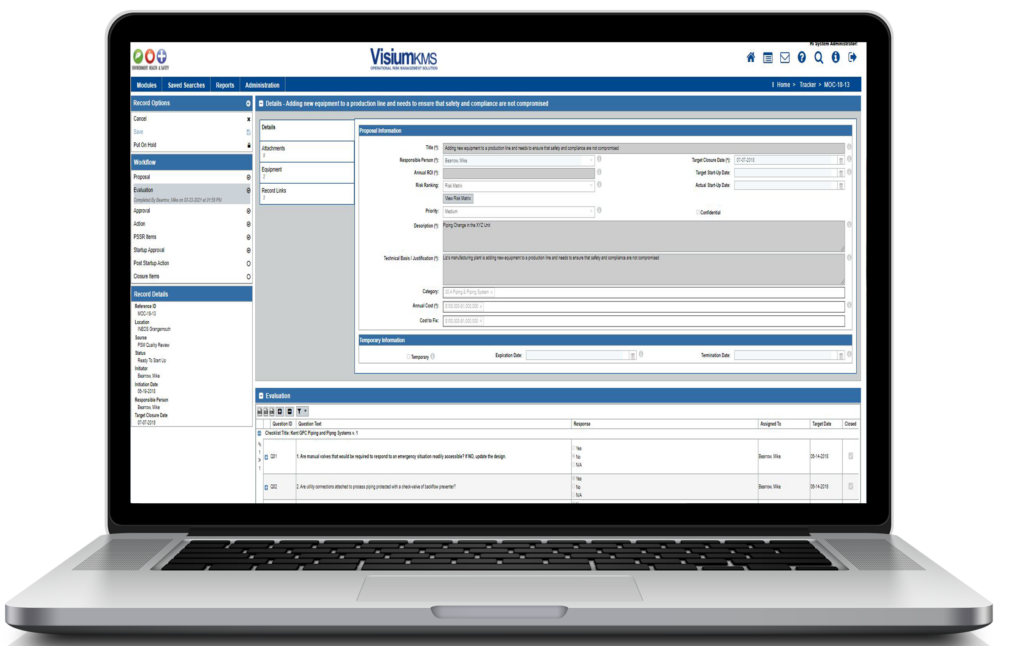
When actions are spread across disconnected spreadsheets, the risk of missed commitments increases significantly. A centralized corrective action tracking software solution gives EHS teams one system for managing actions from audits, incidents, PHAs, MOCs, and other compliance activities.
Instead of searching through multiple files, teams can focus on driving actions to completion and demonstrating that risks have been addressed.
Stop Managing Critical Actions in Spreadsheets
If your team is still tracking audit findings, PHA recommendations, incident investigation actions, and MOC follow-ups in separate spreadsheets, it may be time to rethink the process. VisiumKMS Resolution Tracker provides a centralized platform for capturing, assigning, tracking, and verifying corrective actions across your EHS and process safety programs.
The result is greater visibility, stronger accountability, and fewer recurring findings during audits and compliance reviews.
Learn how VisiumKMS Action Tracking Software helps EHS teams manage corrective actions from a single system.