
Waste Management
Challenges & Trends
The waste management industry plays a crucial role in protecting public health and the environment by safely handling, treating, and disposing of a wide variety of waste streams-municipal solid waste, water treatment residuals, industrial by-products, and hazardous wastes. This sector supports sustainable development by minimizing pollution, recovering resources, and complying with stringent regulations.
Given the diverse waste types and complex regulatory landscape, waste management companies face ongoing challenges in ensuring safety, environmental compliance, and operational efficiency. Advanced technology solutions that streamline Environmental, Health, and Safety (EHS) management are essential to meet evolving regulations and mitigate risks effectively.
Emerging trends, such as the adoption of AI and automation, are helping companies manage safety, reduce incidents, and improve environmental performance. Technology-driven EHS platforms are empowering companies to integrate real-time monitoring, risk assessments, and compliance reporting to ensure both safety and sustainability. Given these challenges, adopting a comprehensive EHS management system is not just a regulatory requirement but a competitive advantage.
Standards and Regulations
The waste management industry is subject to rigorous regulations to ensure worker safety, environmental protection, and product quality. Key regulations include:
-
Resource Conservation and Recovery Act (RCRA):
Mandates cradle-to-grave hazardous waste tracking, storage, and disposal standards. -
Occupational Safety and Health Administration (OSHA): Establishes safety standards to protect workers from hazardous wastes and ensure safe working conditions in processing plants.
-
Environmental Protection Agency (EPA) Regulations: Sets guidelines for managing air and water pollution, hazardous waste, and chemical disposal, aiming to minimize environmental impact.
-
CERCLA (Superfund): Governs cleanup of contaminated sites, holding polluters financially liable
- Clean Air Act (CAA): Regulates emissions from waste management facilities to reduce air pollution and protect public health.
- ISO 14001 Environmental Management Systems:
A globally recognized standard helping companies manage their environmental responsibilities through structured management systems. - EU Circular Economy Action Plan:
Targets 65% municipal waste recycling by 2035, driving EPR adoption globally
Why These Regulations Matter
Compliance with these regulations is essential to avoid penalties, protect workers, and minimize environmental damage. They also help waste management facilities improve operational efficiency, reduce risks, and enhance product quality, ensuring long-term sustainability and a strong reputation in a highly competitive and regulated industry.
Use Cases For Waste Management Facilities
VisiumKMS offers tailored solutions to streamline EHS operations, reduce risks, and help waste management facilities thrive in a challenging, regulated environment. Here is how each module can support your business.
Change Management Tracker
Use Case: The Tracker module enables organizations to meticulously monitor the status and compliance of critical safety equipment, waste containers, and inspection schedules. For example, waste management companies can assign dates to storage containers inspections and chemical inventories to ensure regulatory compliance with EPA and OSHA standards. This prevents overdue inspections and reduces the risk of environmental incidents or regulatory fines by providing real-time alerts and centralized documentation
Risk Assessment
Use Case: The Risk module facilitates comprehensive risk assessments across waste handling, treatment, and disposal operations. It helps identify potential hazards such as chemical exposures, equipment failures, or environmental releases. Waste management firms can prioritize risk mitigation efforts based on severity and likelihood, enabling targeted controls that reduce workplace incidents and environmental impacts. For instance, a landfill operator can use the module to assess leachate seepage risks and implement corrective actions before contamination occurs
Incidents Investigations
Use Case: This module streamlines the reporting, investigation, and root cause analysis of incidents including spills, exposures, near misses, and injuries. Waste management companies can ensure timely and accurate documentation to meet OSHA and EPA reporting requirements. By analyzing incident trends and lessons learned, organizations can implement preventive measures that enhance safety culture and reduce recurrence. For example, a hazardous waste transporter can reduce spill-related fines by over 50% by leveraging this module’s investigation workflows
Quality and CAPA
Use Case: The Quality and Corrective and Preventive Actions (CAPA) module manages deviations, non-conformances, and corrective actions related to waste processing and environmental compliance. It supports continuous improvement by enabling rapid identification of root causes and verification of corrective measures. For instance, a municipal recycling facility can reduce contamination rates and improve material recovery by systematically addressing process deviations identified through this module
Audit & Compliance
Use Case: The Audit module supports planning, execution, and follow-up of compliance audits against regulations such as RCRA, OSHA, and local environmental standards. Waste management companies can generate detailed audit reports highlighting gaps and corrective actions, ensuring continuous regulatory compliance. For example, a water treatment plant can use the module to conduct EPA discharge permit audits, reducing violations and associated penalties
Get in Touch with Our Product Experts
ROI & Results with VisiumKMS
Implementing VisiumKMS in the chemical manufacturing sector can lead to substantial financial gains by enhancing operational efficiency, ensuring compliance, and improving safety performance. Below are key areas where VisiumKMS can help organizations achieve a strong ROI:
ROI & Results
1. Cost Savings through Operational Efficiency
Streamlined Operations: VisiumKMS automates manual EHS workflows such as compliance tracking, inspections, and reporting, significantly reducing labor and administrative costs.
2. Compliance and Risk
Reduced Compliance Costs: By centralizing compliance data and automating audit and incident management, VisiumKMS helps waste management organizations avoid costly fines and penalties.
3. Enhanced Safety Performance
Incident Reduction: VisiumKMS’s incident and observations modules enable rapid reporting, investigation, investigation, and corrective action tracking from root cause to closure.
Example
Example 01:
In an OSHA-cited survey, over 60% of chief financial officers reported that each $1 invested in injury prevention returns $2 or more, and over 40% named productivity as the top benefit of an effective safety program. The commonly cited range is $4 to $6 saved for every $1 invested in an effective workplace safety program. Source: OSHA
Example 02:
Hazardous waste violations under RCRA carry civil penalties exceeding $90,000 per day, per violation — and the most commonly cited violations are documentation failures: missing inspection logs, expired training records, and untracked manifests. Centralized compliance records are the difference between a routine inspection and a liability event.
Source: EPA
Example 03:
OSHA and the National Safety Council identify near-miss reporting as a leading indicator of accident risk: every close call captured and investigated is an incident that never has to happen. The barrier at most facilities isn’t willingness — it’s a reporting process too cumbersome for frontline workers to use.
Source: OSHA
ROI Benchmark
In the waste management industry, experts note that an ROI of over 14% is considered favorable due to the capital-intensive nature of operations. By leveraging VisiumKMS to streamline processes, enhance compliance, and improve safety, companies can achieve substantial financial returns while maintaining operational excellence.
The Visium Advantage
1. Effortless EHS Compliance and Risk Management
VisiumKMS automates EHS compliance with regulations like OSHA, EPA, and REACH, reducing manual processes and minimizing the risk of fines. Our platform reduces manual processes and ensures real-time compliance monitoring, minimizing the risk of costly penalties and reputational damage. These insights help proactively identify and address potential risks in real-time.
2. Risk Intelligence
Our advanced AI agents continuously analyze operational and compliance data to identify emerging risks, automate monitoring, and generate actionable insights. This proactive intelligence helps waste management firms prevent incidents, optimize processes, and adapt rapidly to changing regulations such as RCRA, EPA hazardous waste rules, and local environmental standards.
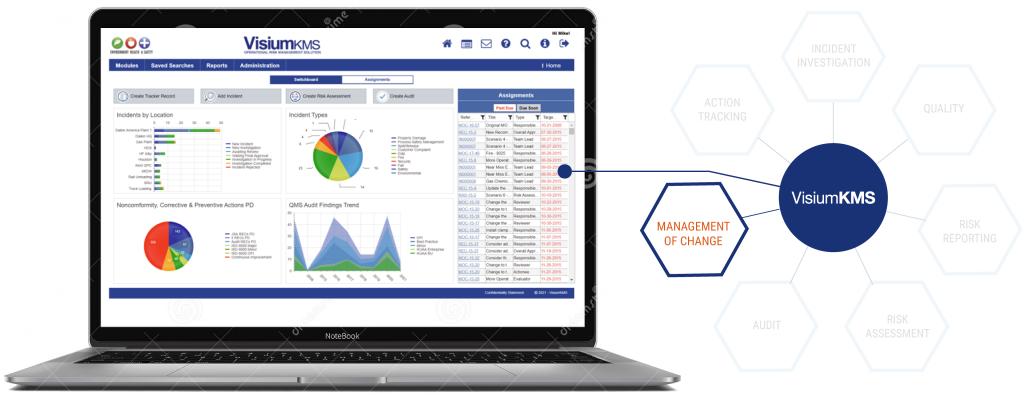
The Risk Intelligence module aggregates data from across your entire VisiumKMS platform — incidents, corrective actions, audits, management of change, and risk assessments — into configurable dashboards built on the KPIs that matter to your operation. Rather than pulling reports from separate systems, waste management firms get a single view of compliance health: open and overdue corrective actions, incident trends by cause, audit completion against plan, and more. Powerful filters and drill-downs take you from an enterprise-level trend directly to the underlying record, so emerging risks are visible while there’s still time to act — whether that’s a pattern of overdue RCRA training records or a site trending the wrong direction on incident closure.
3. Enhanced Worker Safety and Incident Prevention
With VisiumKMS’s incident management tools, waste management sites can prevent accidents, reduce safety risks, and foster a proactive safety culture. With features such as hazard identification, real-time safety monitoring, and incident investigation, the platform helps create a safer work environment. The platform helps lower injury rates and associated costs while improving overall safety performance.
Our Partners
We collaborate with industry-leading companies and organizations that enhance our solutions, validate our capabilities, and ensure the highest standards in EHS management.
S&W Technologies
ENHESA Compliance
Valsoft
Capterra
Software Advice
ASPIRE
Client Testimonial
“User friendly, other businesses had good experience and feedback for Visium KMS. It provided a one-stop shop for Incident reporting, Resolution tracker and recurring tasks, which reduced overall costs.”
C. Mamtu | Manufacturing Excellence Specialist