
When a workplace incident occurs, most organizations focus on one immediate goal: documenting what happened.
But documentation alone doesn’t improve safety. The real value of an incident investigation comes from identifying contributing factors, assigning corrective actions, and ensuring those actions are completed before a similar event occurs again.
This is where many incident management systems fall short. They collect information. They generate reports. They store records. But they often fail to support the complete lifecycle of an investigation.
If you’re evaluating incident investigation software, it’s important to understand what an effective system should actually do—and what capabilities are often missing.
Incident Reporting Is Only the Beginning
Many EHS platforms excel at incident reporting. Employees can submit reports, upload photos, and document injuries, property damage, environmental releases, or process safety events.
That’s important.
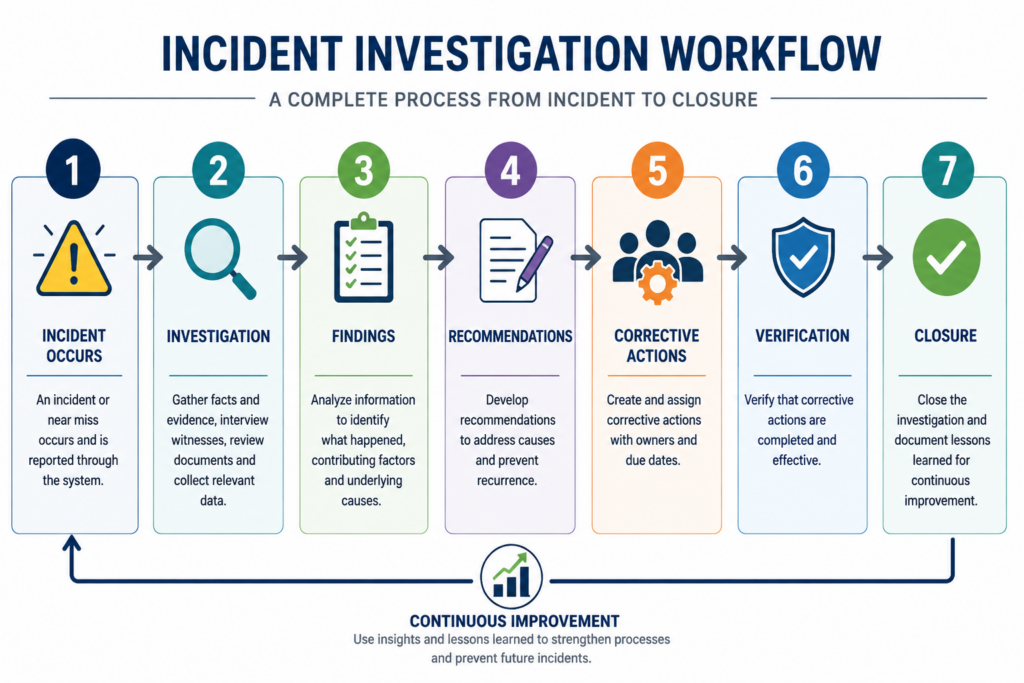
But incident reporting is only the first step. A complete investigation process requires organizations to:
- Capture incident details
- Document findings
- Record contributing factors
- Track recommendations
- Assign corrective actions
- Verify completion
- Maintain an audit trail
Without these capabilities, organizations risk repeating the same incidents because lessons learned never become operational improvements.
What Effective Incident Investigation Software Should Include
Structured Investigation Workflows
Investigations often vary depending on the severity and type of event.
An effective system should provide structured workflows that guide users through the investigation process while maintaining consistency across facilities and departments.
This helps ensure investigations are documented thoroughly and that required information is not overlooked.
Importantly, software should support the investigation process without attempting to perform the investigation itself.
Root cause analysis remains the responsibility of qualified personnel.
The software should capture and organize investigation data—not replace professional judgment.
Support for Near Miss Reporting
Many serious incidents are preceded by multiple near misses.
Organizations that encourage reporting of near misses often gain valuable opportunities to identify hazards before injuries or releases occur.
Effective near miss reporting software should allow organizations to:
- Capture observations quickly
- Standardize reporting
- Route events for review
- Track follow-up activities
- Maintain visibility into trends
When near misses are treated with the same level of rigor as recordable incidents, organizations can often address risks earlier.
Investigation Findings Must Lead to Action
One of the biggest weaknesses in many incident systems is what happens after the investigation report is completed.
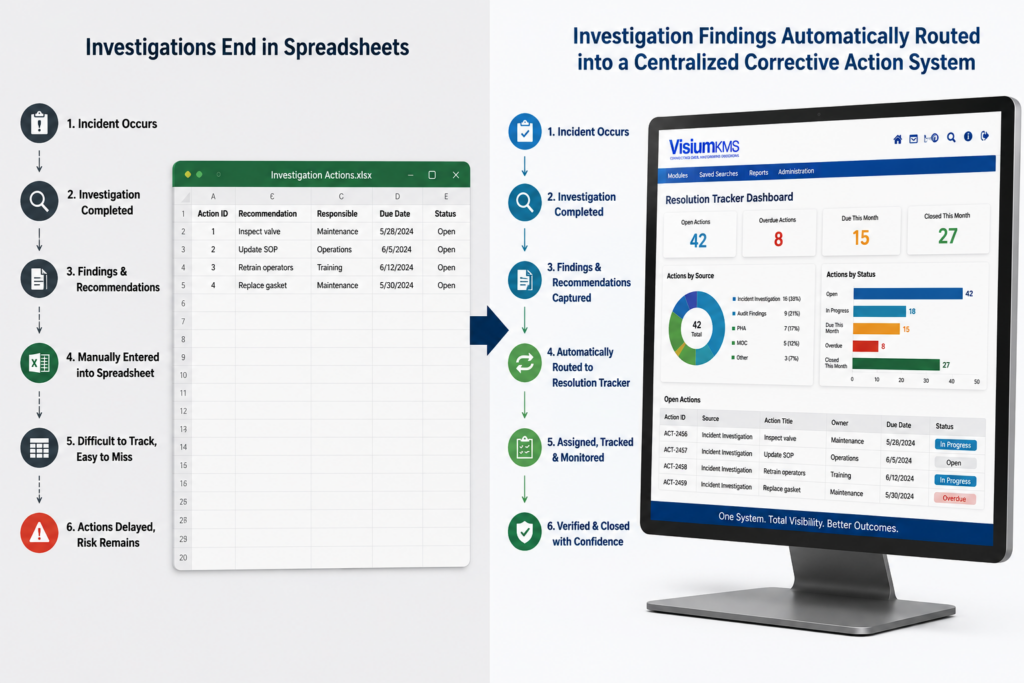
Recommendations are often exported into spreadsheets, emailed to supervisors, or manually entered into separate tracking systems.
This creates several problems:
- Lost action items
- Duplicate data entry
- Poor visibility
- Limited accountability
- Difficulty proving closure
As a result, organizations complete investigations but struggle to ensure corrective actions are implemented.
This is often where auditors identify recurring deficiencies.
The Missing Link: Corrective Action Management
The most effective incident investigation software connects findings directly to corrective action management.
When recommendations are generated during an investigation, they should move seamlessly into a formal action tracking process.
VisiumKMS Investigator supports structured incident investigations while allowing corrective actions to flow directly into Resolution Tracker for assignment, tracking, verification, and closure.
This eliminates the need for separate spreadsheets and reduces the risk of recommendations being overlooked.
For organizations focused on continuous improvement, this connection between investigation and action management is often the difference between documenting incidents and actually reducing risk.
Learn more about the Incident Investigation Module. And for organizations looking to strengthen action tracking across audits, incidents, PHAs, and MOCs, corrective action management is equally important.
Visibility Matters
Many EHS teams manage incidents across multiple facilities, business units, or operating regions.
Without centralized visibility, leadership often struggles to answer basic questions:
- How many investigations remain open?
- Which corrective actions are overdue?
- What trends are emerging?
- Which facilities have recurring issues?
- Are recommendations being completed on time?
Modern EHS incident management systems provide dashboards and reporting tools that help organizations move beyond individual investigations and identify broader operational risks.
Documentation and Audit Readiness
Incident investigations are frequently reviewed during:
- OSHA inspections
- Process Safety Management audits
- Internal compliance audits
- Insurance reviews
- Corporate governance assessments
Organizations need a system that maintains a clear audit trail showing:
- Incident details
- Investigation records
- Findings
- Recommendations
- Assigned actions
- Closure verification
OSHA’s Process Safety Management standard specifically includes requirements for incident investigation and follow-up documentation, making record retention and action tracking particularly important for covered facilities.
Choosing the Right Incident Investigation Software
When evaluating incident investigation software, look beyond reporting forms and dashboards.
Ask whether the system can:
- Support structured investigations
- Capture contributing factors and findings
- Manage near miss reporting
- Generate recommendations
- Track corrective actions
- Maintain closure verification
- Provide audit-ready documentation
The organizations that gain the most value from incident investigations are not necessarily the ones that document incidents best.
They are the ones that consistently turn findings into completed actions.
From Investigation to Resolution
Incident investigations should not end when the report is approved.
The goal is reducing risk and preventing recurrence.
By connecting investigation findings with corrective action tracking, organizations create a more complete safety management process—one that improves accountability, strengthens compliance, and helps ensure recommendations do not fall through the cracks.
VisiumKMS Investigator helps organizations capture structured incident investigation data while Resolution Tracker helps ensure corrective actions are assigned, tracked, and verified through completion.